Skip to content

Archives

Coopers Optique – Small Business Highlight

As a small business ourselves, we know how hard this year has been to navigate. That is why we want to support our neighbors and their small businesses as we continue into 2021! Last month we highlighted Amy Martino, Holistic Sleep and Parenting Coach located here in Seattle and for February we would like to give the spotlight over to Coopers Optique.

“Coopers Optique is an eyewear fashion consultant- curating a sophisticated array of colorful and bold glasses from all over the world. If you are in search of the perfect pair of funky, unique eyewear or sunglasses for your child, Coopers Optique is where you can truly express yourself.”

Below are a few images of some of the products they carry for toddlers and school aged children.

With spring and summer sneaking up on us make sure to check out this little shop in Lower Queen Anne/Uptown Seattle!

Ask a Seattle Sleep Consultant

Hello! I’m Amy Martino, Holistic Sleep and Parenting Coach located here in Seattle.

I’ve supported infants, children and families for over 35 years in many capacities including, Teacher, Nanny, CNCS, PPD, sleep and parenting coach.  My passion is guiding families through struggles and finding what works! I’m intuitive, and one of my tools is astrology, specifically understanding personality and temperament through sun and moon signs.

Currently an empty-nest mama, student, and full time nanny to twin 3.5 year olds.

Please visit www.sunandmoonchild.com to learn more about me!

Q&A

Question:

What are some tips to help wind my child down at the end of the day or before nap time?

Answer:

Routine and consistency are key, plus establishing good sleep hygiene. Reducing or eliminating a child’s exposure to disruptive sounds and blue light during sleep, (and at least one to two hours prior to bedtime), can make a noticeable difference in your child’s ability to drift off to sleep.

A good wind-down period at the end of the day is important to bring-on and maintain production of melatonin.  This can be achieved my having no blue light (screen time), dimming the lights in the house, as well as reducing the noise level, and only engaging in calming activities.  Over activity ramps up cortisol, which is counterproductive to sleep, so active play should take place earlier in the day.

Sleep is brought on by sleep pressure build-up. The spacing and length of naps is important to stave off over-tiredness which can lead to a restless night.  The timing and need of naps changes with the age of the child.

Question:

I’d love any great tips to help toddlers drop the nap and keeping them rested so we don’t hit complete exhaustion by 5pm. My child is still wanting to nap at SLC (school), but doesn’t want to miss out on anything during the weekends, and it’s tough once we get to dinner time without a tired and sometimes fussy boy.

Answer:

FOMO is real!  Naps are important until they’re not.  If your child is still showing strong signs of needing a nap, it’s helpful if you can create the availability of down-time on the weekend.  This can sometimes mean that the whole house goes into ‘quiet time’.  They are less likely to feel they are missing out if there’s nothing to miss out on.  The step-down from nap is quiet time.  A time to rest their bodies.  This can be accomplished in their room with very dim lights (reduce blue light…try red light), or even resting on the sofa with all the blinds pulled.  Be boring at nap time!

Question:

From a teacher: We have a few kids who are visibly extremely tired- heavy eyes, constant yawning, crankiness and will a lot of times be asleep or so close and then wake themselves up- either rubbing their eyes so hard, hitting their heads, or just not willing to keep their bodies still at all and would love to have some feedback on that and any tips!

Answer:

Oof! I’ve been there!  I worked in a child care center many years early in my career.  I will share what I did.  I would ‘make the rounds’ in the room shushing and patting those children first. Often times, the children near them that were less likely to fight sleep, would also drift off while listening to the patting and shushing of the child(ren) I was sitting with.  Placement of the children was helpful as well so you can pat-shush two at once.  The environment was also key, keeping the blinds drawn and having calming music or sound machines playing…and calmly reminding children that it was time to rest their bodies and their minds.  Using ‘that voice’ that would put anyone to sleep, is also key.  Be their guided meditation!

Question:

How do I transition my child from a crib to a bed?

Answer:

So much depends on the age of the child transitioning.  I recommend parents wait as long as they can, doing as much as they can to drop the crib mattress all the way to the floor and other tricks, to hold off as long as possible.  The longer a child has had to be in a well established pattern of sleep, the easier the transition is.  Once everyone’s ready, I recommend moving everything out of the room that can be moved out. Nothing but their bed, some blankets, and lovies.  Things can be slowly returned to the room once there’s a routine and it’s going well.  Having a solid plan in place that they are a part of, and knowing that it will take time and consistency on your part.  This often includes many nights of returning them to their bed…many times.  Consistency, consistency, consistency!

Question:

I have two children that will be sharing a room soon. What are some ways to help make that transition smooth and ensure they both get a good night sleep?

Answer:

Much will depend on the ages of the children. Understanding their particular sleep habits will help determine which child should be put down first etc.  Have a plan. Be consistent and be willing to adjust as you move forward.  It will take time.  Placement of a sound machine between the children can be helpful in creating a ‘wall of sound’ so they are less likely to disrupt one another.  You might have a few days or weeks of adjusting…but, hang in there! Keep the things that are working, while adjusting the things that aren’t.

We would like to thank Amy for taking the time to answer our questions! If you have any other sleep related things you would like to talk about please do not hesitate to reach out to either us or Amy for additional resources.

“Play is our brain’s favorite way of learning.” Diane Ackerman


A Letter from SLC

As we approach our first big break in the school year teachers are likely experiencing some level of teacher burn-out. Because of virtual learning, parents are playing the role of teachers as well. We hope that this upcoming break will allow some time for relaxation and ease some of the new pressures we are collectively facing as a society fighting a pandemic. As you regather yourself and prepare for the final push of 2020, we wanted to share these words with you from Dr. James Corner. We feel that his philosophy on education and development is in line with our goals and philosophy at Seattle Learning Center. We hope that you find comfort in what he has to say and we are here cheering you on, parents, teachers, essential workers, and caregivers.

The following is a message from Dr. James Comer, founder of the Comer School Development Program and professor of child psychiatry at Yale University. With school not in session, it’s time for the home environment to provide what Dr. Comer describes below.

“You know the purpose of the school is not just to raise test scores, or to give children academic learning. The purpose of the school is to give children an experience that will help them grow and develop in ways that they can be successful, in school and as successful adults. They have to grow in a way that they can take care of themselves, get an education, take care of a family, be responsible citizens of the society and of their community. Now you don’t get that simply by raising test scores.

“Our program [at Yale] focuses on the socially interactive aspects of development so that children learn how to manage themselves in a whole variety of situations, and become responsible for managing themselves in a constructive respectful way.

“You are missing a big chunk of [children’s] development if you focus only on curriculum, instruction, and assessment because there is much, much more to being successful in this world.

“Think of it as an adult. What do we do every day? We have to go out in the world, interact with people, get along well with people. We have to elicit a positive response from the people around us in a whole variety of situations. Where do you learn to do that?

“Some children if they’re lucky learn to do it at home, but you should learn to do it at school as well. But the school ignores that part of their growth and development. By focusing on social interactive, psycho-emotional, and moral-ethical education you get improved linguistic expression and reception. And you get improved academic achievement. So you get to the whole spectrum of needs and demands that children will need to be able to function in society.”

Your kids are where they need to be in this present moment and you are doing a wonderful job.

If you have any questions or need any resources please know that you can always reach out to us.

Happy Thanksgiving,

Seattle Learning Center

Get to know Miss Stacey

Miss Stacey has been with Seattle Learning Center since 2017 as the Multi Site Operations Manager. She has worked in childcare for over 10 years and we are just so lucky to have her here at SLC!
1. Why did you choose to work with preschoolers?
They are just so fun! I love having conversations with them, being silly with them and watching them grow by leaps and bounds everyday! It is really special!
2. What was your favorite thing about growing up on the East Coast?
D.C is a great place to grow up! There is something magical about the fall on the East Coast and I loved being able to take advantage of all D.C had to offer- all its history and the Smithsonian museums in particular 🙂
3. What is your favorite thing about the Pacific Northwest?
So much! I love being close to my brother and his family. I love all the beauty, greenness, and coffee! I really love and appreciate the friendly and kind people!
4. What is your go to food craving?
It’s so hard to choose! I guess I would say mac and cheese!
5. Tell us about your weekly recipe resolution of 2020 🙂
I never really learned how to cook or felt skilled in the kitchen and really wanted to change that so for this year I have been alternating between baking or cooking something new every week! I have found that I have really enjoyed baking in particular and gained a lot more confidence and have really surprised myself! Salted Peanut Butter Cookies are up this week 🙂
6. What is your favorite season and why?
While I don’t like that the sun goes down earlier, I really love fall! I love that it has the perfect balance of not being too hot or too cold , starting a new school year, the food and drinks and nothing beats the changing leaves on trees 🙂
7. Favorite moment in teaching so far?
Its not necessarily a moment but I just love all the relationships I have been able to form while teaching with students, staff, and families throughout the years. I love that every day is new and exciting and fun! I love teaching the students and staff and learning from them in return!
8. What kind of music do you most enjoy listening to?
I have a pretty eclectic taste – hip hop, pop, and rock are probably what I listen to the most often but every now and then I will throw some country in there 🙂
9. What has been your favorite country to travel to?
In the summer of 2019 I had the chance to visit South Africa, Zambia, and Botswana and it was the trip of a lifetime a piece of my heart will always be there!
10. If it was possible for you to have any pet in the world, and all accommodations were taken care of, what animal would you pick and why?
I am absolutely in love with Elephants and while I wouldn’t want to take any out of the wild that would have to be my choice!
“In my world there are no bad kids, just impressionable, conflicted young people wrestling with emotions & impulses, trying to communicate their feelings & needs the only way they know how.” Janet Lansbury 

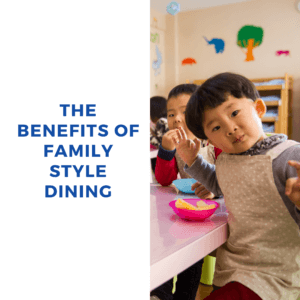
The Benefits of Family Style Dining

Family Style Dining Overview – What it is and the Benefits

Author – Stacey Popowitz

Unfortunately, due to our new COVID19 policies we do not allow the children to self-serve their food. We encourage families to allow children to serve themselves during meal time to practice fine motor skills and portion control, as well as other valuable skills. At SLC we allow children to practice serving themselves as young as 18 months (some children younger depending on their fine motor skills). This does get messy and often times most things don’t make it to the right place, but it is all a part of the process! Have some extra cleaning materials nearby so children can be involved in cleaning up. Having child sized serving tongs and spoons will also be valuable!

Most programs use the family-style dining model to serve meals to the children at their center.  Family-style dining is considered a best practice when eating with children of all ages in child care settings. It involves sitting at the same table with young children, in small groups, with the children serving themselves when possible, and eating together with adults while sharing pleasant conversations. People pass food to one another from serving dishes. It is different from cafeteria-style dining, in which children wait in line and are given single servings of food. Being familiar with family-style dining practices can help food service staff plan for and prepare meals that are congruent with this meal style.

There is plenty of research to support the benefits of family-style dining. The Institute of Medicine’s 2011 Early Childhood Obesity Prevention Policies cites family-style dining as a way for child care providers to practice “responsive feeding,” which includes letting children serve themselves and having adults sit and eat with children to model eating, give guidance on serving sizes, and listen to hunger and fullness cues. Children who participate in family-style dining are more attuned to their natural hunger and satiety cues, are more likely to try new foods, and are more likely to make healthier choices when seeing these choices modeled for them.

Participating in family-style dining with young children includes many benefits, it:

  • Promotes social skills. Children learn to say, “please” and “thank you.” They learn to ask for what they need, wait patiently, and take turns.
  • Prevents behaviors that increase the possibility of arguments, taking someone else’s food, stuffing food into the mouth, potential choking, and playing with food.
  • Promotes language and vocabulary development. Children learn the names of new foods, and adults can model complex language around the size, color, texture, taste, and smell of foods. Meals are also a natural time for conversations about interests and ideas.
  • Models manners and how to use utensils.
  • Establishes warm relationships between children and their peers.
  • Promotes hand-eye coordination as children handle dishes and utensils.
  • Promotes decision-making and problem-solving as children decide what to eat and how much to eat and how to express their wants and needs.
  • Allows children to see adults making healthy choices. This is an excellent opportunity to model these important lifelong behaviors.

Family-style dining has a special look and feel. It should allow caregivers and children to relax, enjoy the meal, and enjoy each other’s company. However, family-style dining does not happen without challenges. Toddlers might spill their drinks, drop their forks, fidget in their seats, and squabble with peers. However, these behaviors are common in early childhood as children gain a greater sense of independence and mastery of their physical skills. You can read more about family-style dining in the attachment below, Benefits and Steps for Family-Style Dining. (https://static.virtuallabschool.org/atmt/food-service/FT.food-service_2.FamilyStyleDining_L1.BenefitsandSteps.pdf)

Information from https://static.virtuallabschool.org/atmt/food-service/FT.food-service_2.FamilyStyleDining_L1.BenefitsandSteps.pdf

“Not by force should the children learn, but through play.” Plato