Skip to content

Archives

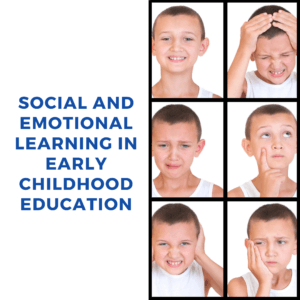
Social and Emotional Learning in Early Childhood Education

Author: Annie King

My grandparents were born during the Depression and its aftermath, so social and emotional learning wasn’t at the forefront of the parenting they experienced, nor of the parenting they gave their Boomer babies.  Growing up in the 60s and 70s, my parents were much more in tune with their emotions than their parents and grandparents, but still, there was no real time to reflect on feelings, nor the skills to label them or talk about them.

I didn’t see my parents struggle. When they had arguments, moments of panic, were feeling sad, were dealing with stressors, etc., that was all dealt with behind closed doors and when my brother and I were “asleep”. Even in moments of happiness, relief, excitement, there was never much expression of these feelings. The message was “don’t express big emotions in public, and even when you express them at home, do it privately”. I am sure my parents would be embarrassed to know that that’s what I learned from them about dealing with emotions, but that is what was modeled. It could be that they solved their problems effectively and with emotional intelligence when behind closed doors, but I didn’t get to see the resolution, or how the feelings were dealt with. Observing this process is necessary, vital, to learning.

When I was in high school and college, I started to face bigger problems than I had as a child and experienced the natural stress and uncertainty that accompany becoming an adult. But I didn’t know how to handle the feelings that go along with these big problems. This didn’t always prevent me from working through the problems, but at times it did. And even when it didn’t stop me from being a successful student, participating in extra-curricular activities, or having a social life, I was followed by the emotional baggage that wasn’t dealt with when it was happening.

In short, this is why the study of social and emotional learning is so interesting to me, and why I think it is so important to teach starting at birth. I hope that by the end of this post, you will feel as strongly about it as I do.

Social and emotional learning (SEL) is the process through which children and adults acquire and effectively apply the knowledge, attitudes, and skills necessary to understand and manage emotions, set and achieve positive goals, feel and show empathy for others, establish and maintain positive relationships, and make responsible decisions.¹ SEL is divided into five core competencies. Check out this diagram, then we will dive deeper into each component.
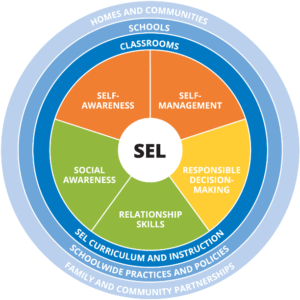
(Core…)

The first competency is self-management. Self-management is the ability to successfully regulate one’s emotions, thoughts, and behaviors in different situations (Core…). Examples of this include taking deep breaths when crying or finding one’s own space when upset.

The second competency is self-awareness, which is the ability to accurately recognize one’s own emotions and thoughts and how they influence behavior (Core…). We see this when someone says “ugh, I am feeling so frustrated” or after running and jumping, noting that they did that because he or she “felt really excited”

The following competency is social awareness; the ability to take the perspective of and empathize with others, including those from diverse backgrounds and cultures (Core…). This is a big leap, but this can be bridged by continued support in the first two competencies. Even as adults, we struggle to approach situations and people with empathy, and act in a way that takes diverse perspectives and cultures into account.

The fourth SEL competency is relationship skills, defined as, the ability to establish and maintain healthy and rewarding relationships with diverse individuals and groups (Core…). You can see how each competency builds on the ones that precede it. If we cannot regulate and label our emotions, or if we cannot be social aware of other ideas, backgrounds, or cultures, we cannot possibly maintain healthy relationships.

The final component to social and emotional learning is responsible decision-making. This is the ability to make constructive choices about personal behavior and social interactions based on ethical standards, safety concerns, and social norms (Core…). With a strong foundation from the first four competencies, people can be responsible decision makers. Unfortunately, we often want people to automatically be responsible decision makers, without giving them the tools to master the skills of self-management, self-awareness, social awareness, or relationship skills first.

So how do children learn SEL?

Children learn about emotions and social behaviors through direct instruction, by observing what others do and say, and by attending to how others react and respond to their expressions and behaviors. Most importantly, your children look to you (and us teachers/other adults who care for them) to see how to handle things. If you spill a glass of milk and curse, most likely, then next time your child spills milk you will hear that same expression come out of that sweet little mouth of theirs. (We have all been there!)

The following are ways in which we support SEL in the classroom, which can also be how you support it at home:

  • Give explicit instructions
  • Provide scaffolding
  • Practice through books
  • Model rules and expectations
  • Validate and encourage the expression of feelings
  • Guide children toward reflection

There has been a fair amount of research conducted over the years about social and emotional learning, and the importance of emotional intelligent children. Dr. John Gottman is one of these pioneer researchers in SEL. Research by Gottman shows that emotional awareness and the ability to manage feelings will determine how successful and happy our children are throughout life, even more than their IQ. Being an Emotion Coach to our kids has positive and long-lasting effects, providing a buffer for the complexities of life that allows them to be more confident, intelligent, and well-rounded individuals (Gottman 2015).

Gottman provides three “dos and don’ts” of raising an emotionally intelligent child:

  • Do recognize negative emotions as an opportunity to connect.
    • Don’t punish, dismiss, or scold your child for being emotional.
  • Do help your child label their emotions.
    • Don’t convey judgment or frustration.
  • Do set limits and problem-solve.
    • Don’t underestimate your child’s ability to learn and grow.

(Gottman 2015)

All this information is of incredible value to us educators and parents, but it is easy to look at things from a theoretical standpoint. How does this look in real life when you are overworked, dealing with life during a pandemic, parenting, and more?

Here is an example of how I have modeled: One day in Sunshine I spilt the entire container of milk while serving lunch. I mean, the entire thing. On me, on the floor, on the table and chairs. I said “Oh, gosh! Look what I did! I spilled ALL the milk! Ugh that’s frustrating and pretty embarrassing. I am also feeling a little upset that I made this big mess that I have to clean up now.” Then I took some visible and audible deep breaths. “Okay, that feels better. Now I am ready to clean it up. Spills happen and I can fix this problem.” Then I did. This probably sounds silly and an over-exaggeration of a reaction but showing the students how to appropriately express and label these feelings, and how that leads to calm problem solving and self-regulation.

We often see SEL teaching moments when a child is having big emotions. Sometimes the cause of these big feelings is obvious; a friend stole my toy, I fell and hurt my hands and knees, I am tired, etc. Other times, it is not clear, and when dealing with kids who are still learning how to speak, telling us “why” sometimes isn’t realistic or even possible. Here is another example: One day I was taking a Sunshine friend potty when they woke up from nap. This friend woke up unhappy, emotional, and crying. First, she expressed, “I want mommy and daddy!”, then when in the bathroom she saw a scrape on her knee from earlier in the day she said, “Ow my knee hurts”. After both times, I repeated what she said back to her to let her know that I heard what she said: “I hear your knee is hurting you. That must be uncomfortable and maybe even painful. I am here to help you. How does it make you feel?” Despite no answer, I know that she began examining how she was feeling. Then we problem solved together: “What do you think would help you feel better? Hm… Would a hug help? No. Do you want to take deep breaths together? No. Would you like a bandaid? No. Would you like an ice pack? Yeah, I want an ice pack.” Maybe her knee didn’t even hurt anymore, maybe she really was missing mom and dad, maybe her body wasn’t really ready to wake up, but with support and guidance, she found a solution that she thought would help her manage her feelings, and it did.

It is not easy to reteach yourself something that has been a part of your life for decades, and to not naturally model what parenting you experienced, but once you get the hang of it, it really does make things so much easier. And as Gottman put it, social-emotional intelligence better predicts a happy, healthy, and successful future even more than IQ, and we all want that for all our kids (Gottman 2015).

We have lots of additional resources at school on SEL, including books, articles, and websites if you are interested. One of our favorite activities is making a feeling faces book; a picture book of all the kids making different faces with emotion labels. The kids love making and looking at it, so try it out at home!

Works Cited

“Core SEL Competencies.” Collaborative Academic, Social, and Emotional Learning, casel.org/core-competencies/.

Gottman, John Mordechai, et al. Raising an Emotionally Intelligent Child. Simon & Schuster Paperbacks, 2015.

“It is a happy talent to know how to play.” Ralph Waldo Emerson
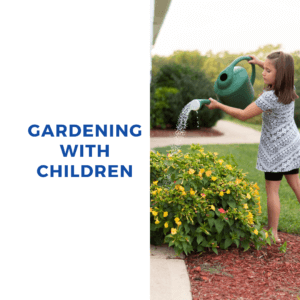

Gardening with Children

From Seed to Salad Training from Successful Solutions Training

This week I, (Miss Ashley) took a training on gardening and why it is important to incorporate it in the classroom or at home. I am excited to share this with you because this training had some great resources and insight on gardening with young children.

Why start a garden?

Having a garden and growing plants with children can teach a variety of important things. If you choose to grow fruits and vegetables it can open up the conversation for healthy eating and sustainable living. Gardening is cost effective and provides a sensory experience as well as a family activity. It is also a life-long skill that can be passed down to generations!

What can a garden teach children?

Children have a natural curiosity of how the world around them works. Gardening allows them to explore and learn about things that are likely, already very interesting to them! It can stimulate their imagination, encourage them to use creative problem-solving skills, and allows for quality time outdoors.

There are many life skills that are practiced when planting a garden. Children have to practice being patient as they wait for their plants to sprout and grow, it exposes them to cause and effect (what happens when plants get watered?), teaches them responsibility, and it helps their self-esteem as they become increasingly proud of their garden. It also can help children learn respect and care for the environment.

Now more than ever, teaching children habits for healthy living is important. In the last 30 years childhood obesity has more than doubled. As children learn where fruits and veggies come from, they may be more interested in trying new ones.

And lastly, gardening can help teach children teamwork and working together. If the class or the family works together at creating the garden this allows for the development of social skills as kids learn to work as a team. This helps to build community as well, especially if there is a harvest party at the end of the season to celebrate everyone’s hard work.

Things to consider when starting your own garden

Space Will this be a windowsill garden or outside in the yard?

Equipment Child size equipment is important as it will help the child be an active participant. A small rake, child size gloves, and small shovel are great!

What to plant Allow kids to have a say in this! This can help them get more excited and more invested in the process. This will also encourage a sense of responsibility to the garden.

Some plants die This may be disappointing for children and it is also ok. This presents a learning opportunity and if possible, try and grow the same plant with new circumstances to practice the scientific method. Discuss what may have gone wrong and give it another try.

Use plants that grow quickly Kids may lose interest if a plant takes too long to sprout!

Some great examples of plants to grow are radishes, sunflowers, and lettuce. Be sure to do a little research and see what plants grow best in what season!

Below are two resources for gardening with kids. One is a great booklist about gardening that will continue to spark your child’s or your student’s curiosity. The other is information about getting that garden started.

https://kidsgrowingstrong.org/

https://www.pbs.org/parents/thrive/best-gardening-books-for-kids

Good luck and happy gardening!

“Childhood is not a race to see how quickly a child can read, write and count. It is a small window of time to learn and develop at the pace that is right for each individual child. Earlier is not better.” Magda Gerber

4 Play Invitations for Infants


We have all experienced that feeling of being torn between entertaining our infant or spending the quick 10 minutes to do the dishes. Our baby seems to be uninterested in the spatulas and silicon teethers all of a sudden and that goal we had set to clean the kitchen before noon might not actually get accomplished.

Like adults and older children, sometimes babies just need something new. Here are 4 play invitations for infants that we think your little one may enjoy!

But first, let’s define play invitation. Invitations for play in childcare are an absolute necessity for teachers and once implemented into your routine, say before breakfast is served, a play invitation might save you some sanity as well. A play invitation, or invitation to play, is something that is set up in the environment and arranged in a way to “invite” a child to play with it. These invitations to play should allow for as much independent play as possible. Easy examples would be blocks already stacked and set up to start building or art materials arranged and ready to be turned into a masterpiece.

Infants can have play invitations as well! See below for 4 examples of play invitations.

Sensory activities

Infants love things that are colorful and textured. Using clear bags or bottles, (tightly sealed) place different items inside like pom poms, buttons, or beads so that your baby can explore the colors, sounds, and texture of their sensory activity.
Water play

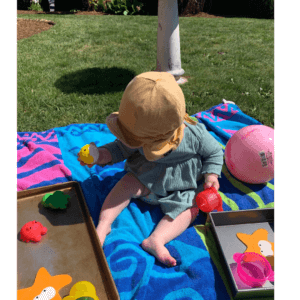
Now we all know that water play is often a huge hit and often pretty messy, but hear us out! Using cookie sheets and cake pans allow for minimal water. We like to use bath toys and toys that have a suction cup so that babies can practice grabbing things at different depths and pulling on things that are suctioned to the bottom. Your baby will get wet but if you place a towel down clean up can be as quick as putting the dishes/toys in the sink, the towel in the laundry, and a change of clothes on the baby. A 5 minute clean up could buy you much more time especially if your little one loves water play!
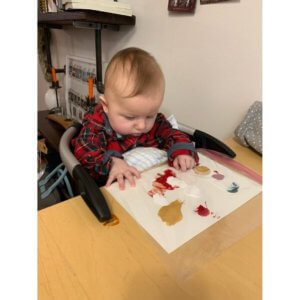
Art

That is right, babies can do art too! Placing paper and paint into a plastic bag that is taped to the table (or not) allows your baby to move the paint around, mess free. The mixing of colors will be a fun experiment and great sensory activity.
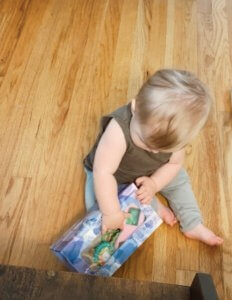
Playing with boxes

We all know that kids like the box almost, if not more, than the toy it came in right? Well, take it a step further and put toys in an empty Kleenex box. Your baby will spend some time shaking the box and reaching in to get whatever you hid away inside. Eventually your baby will learn how to put the items back inside and have fun experimenting with this new skill. Not to mention what a great fine motor activity!

Have any go to activities that your baby just loves? We would love for you to share them with us!

Never help a child with a task at which he feels he can succeed.” Maria Montessori

War Play Dilemma

The War Play Dilemma

By Alex Esarey

This blog is a summary of the book The War Play Dilemma by Dianne Levin and Nancy Carlsson-Paige. A teacher, Alex Esarey who used to work at SLC read the book and wrote this summary for SLC staff and parents. The book is a vital resource for adults who are concerned about the influence of violence as seen via the media (television, movies, video games, and media-linked toys).

It’s obvious to anyone who spends time with youth that they are fascinated by “war play”, be it ninjas or something similar. And no wonder: the amount of violence has been increasing steadily since we were children. For example, each Power Rangers episode averaged about 100 acts of violence, twice as many as the Teenage Mutant Ninja Turtles. It is estimated that by the end of elementary school, the average child will have seen 8,000 murders and 100,000 other acts of violence seen on the TV screen (as of 1999- I can only imagine that these numbers have since increased!)

But does violent TV really equate into anything? After all, many of us loved watching Teenage Mutant Ninja Turtles when we were children and we are completely well-adjusted adults. However, the American Academy of Paediatrics, the American Medical Association, and the American Psychological Association warns that after reviewing hundreds of studies, they have found that there is a definite connection between media violence and aggressive behaviour in youth, and that children who are exposed to violent media become desensitized to violence in real life. In other words: children exposed to violent media at a young age are more likely to engage in violent and aggressive behaviour later in their life.

However, here is the catch: not all war play is bad. The book goes into greater detail, but here is the gist: there are two types of war play.

  1. War play as play. This kind of war play is healthy for children. Each play session is different and unique. (For example, one day it might be dragons vs. witches; the next day mermaids vs. monsters.) It allows children to work through important developmental issues such as separation, feelings of control/power, impulse control, and a sense of mastery over violent content (such as working through seeing something violent on the news channel).
  2. War play as imitation. This type of play is when the same “script” is used again and again; there is no creativity involved, and there is no resolution, evolution, or conclusion to the story (leaving the child feeling empowered). More often than not, they are literally repeating what they have seen on TV. Media-based toys encourage this sort of play. It creates violence into something fun, exciting, and innocent. The children do not seem to explore that violence, its effects on others, or alternatives to the violence. They do not learn any deeper lessons from their play, but simply reconfirm the images of glorification of violence as seen on TV.


Unfortunately, war play as play is seen less and less; play is becoming more violent and militaristic than it has in the past. Why? Rather than using their creativity, they are simply imitating what they see on TV. So how do we find a healthy medium? How do we allow our children to process their developmental issues while keeping them innocent?

There are five different ways to approach war play: 1) ban all war play, 2) take a laissez-faire approach, 3) allow war play, with limits, 4) actively facilitate war play, and 5) limit war play but provide alternative ways to work on the issues.

The authors of The War Play Dilemma suggest option four and option five. I would recommend reading the book for specifics, but here is some general information about those tactics:

  • Tactic four: actively facilitate war play: this approach allows the child to work through developmental issues, as well as engage in creative thinking. However, it demands a high level of attention and participation in play. As the adult, it is your role to suggest new roles, offer new materials, and assume a role in their play. Most importantly, it is the role of the adult to ensure the play has the political and moral ideas that are desired. For example, you will play about topics such as enemies and friends, good and bad, war and peace- all this is within the realm of influence. This option is an excellent one, but requires a high level of involvement from adults. As such, at school (due to child to adult ratio) I use the next model, tactic five.
  • Tactic five: limit war play, but provide alternative ways to work on the issues: this method allows children to explore war play themes through alternative methods, such as art, drawing, building, conversations, and using children’s books. For example, instead of becoming Spider Man, tactic five would encourage the children build a house for Spider Man. When we implement Option 5, we tell children we are banning war play because children are getting hurt, or that it’s too scary. At the same time, we can suggest what they can do, such as having a special time when they can make pictures about the themes they like. This tells the children we are interested in their interests and willing to talk about what interests them.

Here are some guidelines for resolving the war play dilemma:

  1. Limit children’s exposure to violence, including violent media and products linked to it.
    1. Learn about the TV shows they are watching.
      1. Great alternatives to violent media include: Dora the Explorer, The Bearnstain Bears (I would recommend the 2003 TV show, not the 1980’s version; the 2003 version contains fewer “potty words”), The Magic School Bus, Sesame Street, Wishbone, Bubble Guppies, The Backyardigains, and Go, Diego, Go! (Note: I have not personally seen the last three on this list; so I cannot personally vouch for them).
    2. Work out routines as to when media are and are not consumed. Having definite times of the day when children watch TV can help avoid constant nags.
    3. When children do see violence, help them deal with what they have seen.
  2. Help children learn to engage in creative and meaningful dramatic play of all kinds.
    1. Actively introduce new content into their lives, such as new characters.
  3. When children engage in war play, learn as much as you can about the nature of their play and the issues they are working on.
    1. Where do children get the ideas for the scripts; from direct experience, their imagination, or from TV?
    2. What is the degree to which children are imitating and repeating a particular script over and over?
    3. What are possible developmental issues they are working through?
  4. In children’s war play, address the issues raised by both the developmental and socio-political sides of the war play dilemma
    1. Know the “scene” in the popular culture that is influencing war play. Watch your children’s shows; see what they are really all about.
    2. Foster early political ideas in ways that build the concepts revealed in the play in less militaristic, more humanistic directions. For example: “where does the bad guy go when he’s not fighting?”
    3. Try to avoid placing adult value judgements on their play.
    4. Use open ended questions and comments related to the violence to help children find new problems to solve and to get beyond the narrow focus of violence.
  5. Work to counteract the lessons about violence and stereotyping that children may be learning.
    1. Try to humanize the enemy.
    2. Help sort out hat is pretend and what is real.
  6. Talk to our government! Many other countries have already struck a better balance between our children’s and corporate interests. Sweden and Norway have restrictions on the sale of war toys, Malta prohibits their importation, Greece bans TV ads directed to children, and Australia places restrictions on war toy imports. It’s time for America to step up to the plate!

In conclusion, I believe that violent media can be very damaging to children. Unfortunately, it is all around us; it’s at Target and on the TV. It’s our job as adults to know what to do with this, the War Play Dilemma. Here is an additional article, Beyond Banning War and Superhero Play, that is a great read.

If you have any questions or would like to talk about this topic further, please do not hesitate to reach out!

“Do not tell them how to do it. Show them how to do it and do not say a word. If you tell them, they will watch your lips move. If you show them, they will do it themselves.” Maria Montesorri 


Miss Tanya’s Chili

This recipe is a kid favorite at SLC Queen Anne. The kids get extra excited for a bowl full of Miss Tanya’s special chili after a morning well spent playing and learning with friends.

This recipe has the measurements to feed about 35 children so make sure to adjust the proportions accordingly!

SLC Black Bean Chili and White Basmati Rice

Ingredients
(Makes a giant amount)

The Rice

7 C Basmati Rice
18 C drinking water
1 T salt
2 T olive oil

Directions

Cook the rice in the giant rice cooker, first thing in the day.  When finished cooking, turn off the rice, not letting it keep ‘warm’, which dries it out.  Put into containers for serving in the classrooms.  Use a fork to fluff the rice so it does not clump together.  You can then cook the chili in the same rice cooker pot.

Ingredients

Black Bean Chili

2 #10 cans of black beans, pinto beans, kidney beans or navy beans
1/2 cube of butter, one stick
1 head of garlic, finely chopped
2 C onions
2 T cumin
2 t. dried oregano
2 T salt
2 (28 oz.) cans of crushed tomatoes
6 bell peppers; red, yellow & orange
2 T fresh lime juice

Directions

Finely chop the garlic.  Dice the onion(s), small.   Microwave the onions with the butter until translucent and tender.  Add the garlic and cook another minute or two, only.  Do not brown the garlic.

Finely dice the peppers, no larger than the beans.

Put the beans in the rice cooker, turn on cook.  Add the canned tomatoes.  Add the onions and garlic.  And the spices and herbs.

Let the pot boil until the peppers are tender, about 15 – 20 minutes.  When the peppers are tender, the chili is finished cooking.  Any further cooking will boil away the juices, so keep the continual heating to a minimum.  If you would like, you can add some vegetable stock or tomato soup to the chili, for a soupier chili.  Reheat as necessary before serving.

Put the chili into serving containers for the classrooms. The Rice Paddles are helpful for serving the rice in the classrooms.  The red plastic measuring cups are useful for serving the chili.

Let us know how your chili turned out!

“It is a happy talent to know how to play.” Ralph Waldo Emerson